
On this page 8 sections
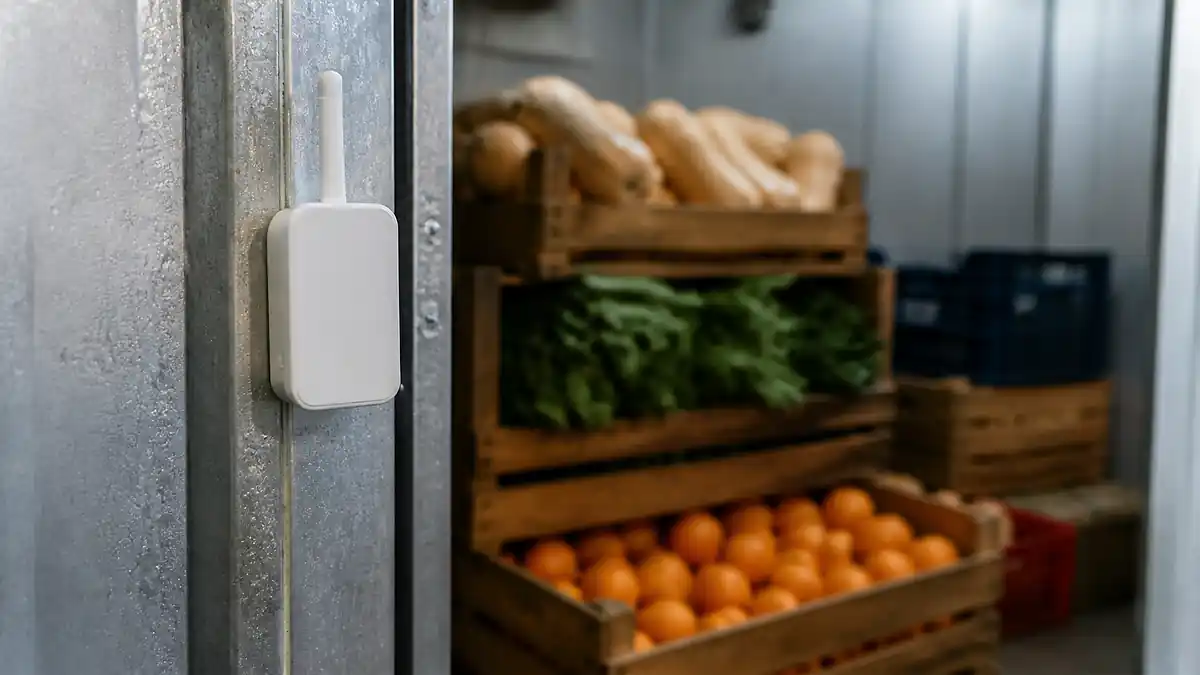
What is IoT? IoT, short for the Internet of Things, means everyday physical objects fitted with sensors and a network connection, so they can report what is happening and sometimes act on it without a person checking by hand. A fridge that sends a message when it warms up, or a water tank that reports its level, is IoT.
Short answer
- What it is: physical "things" (machines, meters, vehicles, rooms) with sensors that send readings over a network.
- Why it matters: you see problems as they happen instead of finding out later, and you stop paying people to walk around and check.
- Where it is used: cold rooms, farms, factories, vehicle fleets, buildings and backup power.
- What to watch: security, privacy, power and signal, and collecting more data than anyone will use.
How IoT works in four parts
There is no single official definition of IoT, as the US National Institute of Standards and Technology (NIST) (opens in a new window) points out. A useful working version from NIST is that an IoT device has at least one sensor or switch that touches the physical world, and at least one network connection. Most business systems have four parts.
1. The device
A sensor measures something: temperature, humidity, movement, vibration, location, power use or the level of a tank. Some devices also act, for example by switching a pump or opening a valve. These are called actuators.
2. The connection
The device sends its readings over a network. Which one depends on distance, power and how much data you send:
- Wi-Fi or Bluetooth for short distances inside a building.
- Cellular (4G, 5G and low-power options) where there is mobile signal and a power source.
- LoRaWAN for long distances with very little power. The LoRa Alliance (opens in a new window) says it runs on free, unlicensed radio bands and that devices can last more than 10 years on a battery, which suits farms and remote sites. Many systems send messages with MQTT (opens in a new window), an open standard designed for small devices and slow or expensive connections.
3. The platform
Readings land in a central system that stores them, checks them against rules and shows them on a dashboard. This can run in the cloud or on a server at your premises. Our cloud and DevOps page covers how to choose.
4. The action
This is where the value is: an SMS when a cold room goes above 5°C, a job card when a machine starts vibrating more than usual, or a monthly report on energy use. Without this step, IoT is just expensive data. Connecting readings to the systems you already use is mostly software development work.
The benefits of IoT for business
- Early warnings. A sensor checks every minute, day and night. You hear about a fault before stock spoils or a machine breaks.
- Less manual checking. Staff stop walking to tanks, meters and fridges with a clipboard.
- Lower running costs. Seeing exactly where power, water or fuel goes makes waste easy to spot.
- Planned, not emergency, maintenance. Trends in temperature or vibration show when equipment needs a service, so you can book it at a quiet time.
- Proof. Automatic logs show that food stayed cold or a delivery arrived on time, which helps with audits, insurers and customer disputes.
- Better decisions. Months of real readings beat guesses. With good data and reporting, and sometimes AI to spot patterns, the numbers turn into clear choices. IoT is already everywhere. The Ericsson Mobility Report (opens in a new window) estimates about 22.3 billion IoT connections worldwide at the end of 2025, and forecasts 47.1 billion by 2031.
Common IoT uses in South African businesses
| Business | What is measured | What it gives you |
|---|---|---|
| Food retail and restaurants | Cold room and fridge temperature | Alerts before stock spoils, and a temperature log for inspections |
| Farming | Soil moisture, tank and dam levels, weather | Water only when needed, fewer trips to check remote points |
| Manufacturing | Machine vibration, temperature, running hours | Earlier repairs and less unplanned downtime |
| Transport and logistics | Vehicle location, fuel, driving events | Live tracking, fuel control, proof of delivery |
| Offices and buildings | Power use, occupancy, door access | Lower electricity bills, safer buildings |
| Any site with backup power | Inverter, battery and generator status | Know before batteries run flat or a generator fails to start |
The best first project is usually small and painful: one problem that costs money every month and that a single type of sensor can watch.
IoT risks and how to manage them
Security
Cheap devices with weak passwords are an easy way into a network. The UK now requires connected consumer products to have unique or user-set passwords, a way to report security problems, and a published period of security updates, under rules in force since 29 April 2024 (opens in a new window). South Africa has no equivalent law, but those three points make a good buying checklist. NIST's IoT security baseline (opens in a new window) adds encrypted data and secure software updates. Keep IoT devices on a separate network from your office computers.
Privacy and POPIA
If devices record people, such as cameras, door access or vehicle trackers linked to drivers, you are handling personal information. POPIA section 19 (opens in a new window) requires reasonable technical and organisational measures to protect it. Collect only what you need and decide upfront who can see it.
Approved equipment
Under the Electronic Communications Act, communications equipment, including radio devices, must be approved by ICASA (opens in a new window) before it is sold or used in South Africa. Ask your supplier for proof of approval, especially for imported devices bought online.
Power and signal
Plan for outages. Choose battery-backed devices that store readings and send them when the connection returns, and test signal at the exact spot where each sensor will go.
Too much data
Thousands of readings a day are useless if nobody looks at them. Decide which numbers trigger an alert and which only go into a monthly report before you buy anything.
Is IoT right for your business?
IoT is likely worth it if you can say yes to most of these:
- There is a physical problem that costs you money regularly (spoilage, downtime, theft, waste).
- Someone currently checks it by hand, or nobody checks it at all.
- You know what you would do when an alert arrives, and who would do it.
- The device can get power and a signal where it needs to go.
- You can start with one site or one machine and measure the result. If you can't answer the third point, start there. A clear "if this, then that" plan matters more than the hardware.
How we can help
We connect the data from sensors and machines to the systems you already use: dashboards, alerts, reports and your business software. That includes tools such as Node-RED for collecting and routing readings and Grafana for live dashboards, with security built in from the start. See our software development services or get in touch to talk through your first project.
Facts checked on 17 November 2026. Sources: NIST IoT definitions (opens in a new window), Ericsson Mobility Report (opens in a new window), LoRa Alliance (opens in a new window), OASIS MQTT 5.0 (opens in a new window), GOV.UK PSTI regime (opens in a new window), ICASA type approval (opens in a new window), POPIA section 19 (opens in a new window).
Let's work together
Ready to talk? We'll reply within 2 working days. Get in touch